.png)
.png)
Sora, Veo, and the Rise of AI Video
Sora, Veo, and the Rise of AI Video: What Brands Need To Know Now
If 2024 was the year generative AI learned to write and code, 2025 will be remembered as the year it learned to direct. The past twelve months have seen an unprecedented acceleration in the capabilities of AI video generation models, transforming them from experimental novelties into powerful enterprise tools. With the recent public rollout of OpenAI’s Sora 2 and the deep integration of Google’s Veo 3 into the corporate workspace, the infrastructure for a new era of content creation is now in place.
But the most seismic shift occurred just yesterday. The announcement of The Walt Disney Company’s $1 billion investment and multi-year partnership with OpenAI has sent a clear and undeniable signal to the global business community: AI video is ready for prime time. Disney, the world's premier storyteller and guardian of some of the most valuable intellectual property on the planet, is entrusting its characters to Sora. This is a watershed moment that validates the technology and will accelerate its adoption across every industry.
For brands, the implications are profound. The question is no longer if you will use generative video, but how quickly you can integrate it to gain a competitive advantage. As we stand on the cusp of 2026, here is the essential briefing on the titans of AI video and the strategic moves your company needs to make.
The New Titans: A Deep Dive into Sora 2 and Veo 3
The AI video landscape is crowded, but the battle for enterprise dominance has coalesced around two major players, each representing a distinct philosophical approach to video generation. Understanding these differences is key to building the right tech stack for your brand.
The image below provides a visual framework for understanding the core strengths of these two industry leaders.
Sora 2: The Master of Physics and Realism
OpenAI’s Sora 2 has established itself as the benchmark for visual fidelity. Its core strength lies in its ability to simulate the physical world with uncanny accuracy. Unlike earlier models that would often "hallucinate" movement, Sora 2 understands physics. If you prompt it to show a glass vase falling, it doesn't just animate a generic break; it simulates the shatter, with shards of glass following realistic trajectories based on gravity and momentum. This makes it the tool of choice for high-end applications.
- Key Strengths: True physics simulation, photorealistic lighting and textures, and multi-shot consistency that allows for complex camera movements without the subject warping.
- Best Brand Use Cases: Creating high-end product commercials, prototyping visual effects for campaigns, and generating "impossible shots" that would be too expensive or dangerous to film in real life.
Veo 3: The Engine of Integrated Storytelling
Google’s Veo 3 has taken a different path, focusing on the holistic video creation process. Its primary advantage is its deep integration with audio and its ability to maintain narrative flow. Veo 3 doesn't just generate visuals; it generates synchronized audio, including realistic dialogue with perfect lip-syncing, ambient background noise, and Foley sound effects that match the on-screen action. Furthermore, its embedding into the Google Workspace ecosystem via Google Vids makes it incredibly accessible for everyday business workflows.
- Key Strengths: Native audio generation, superior lip-syncing for character dialogue, scene extension capabilities for longer-form content, and seamless integration with existing Google tools.
- Best Brand Use Cases: Producing high-volume social media content, creating personalized video messages for customers at scale, developing internal training videos, and crafting narrative-driven ads where dialogue is essential.
For many brands, the answer won't be choosing one over the other, but rather using both in a complementary workflow. A high-end product shot generated in Sora could be imported into a Veo-powered editor to add a character-driven narrative and synchronized voiceover.
The Disney Effect: A Turning Point for Brand Adoption
The importance of the Disney-OpenAI partnership cannot be overstated. For years, a primary barrier to enterprise adoption of generative AI has been fear—fear of copyright infringement, fear of brand safety, and fear of low-quality output damaging a brand's reputation. Disney, a company whose entire empire is built on the vigilant protection of its intellectual property, has just shattered that barrier.
By investing $1 billion and agreeing to license its iconic characters for use within Sora, Disney is making a massive vote of confidence in the technology's maturity and safety. This isn't just an R&D project; it's a strategic business move to integrate AI into the core of their content creation engine.
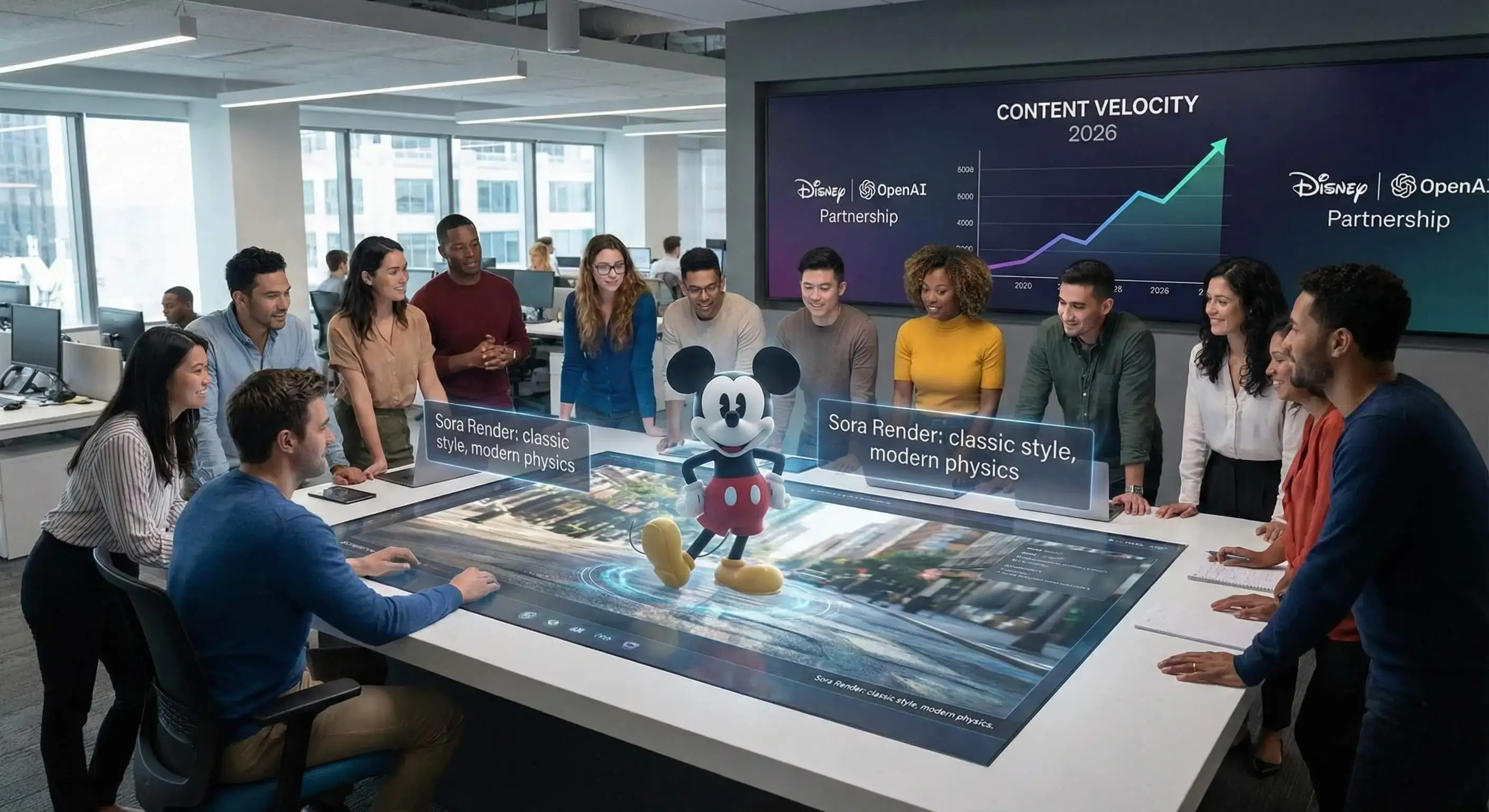
The image below captures the spirit of this new era, showing a modern creative team collaborating with AI to bring beloved characters to life.
This partnership signals to every other brand board room that the risks are manageable and the rewards are too significant to ignore. We can expect a domino effect in 2026, with major brands in fashion, automotive, and consumer goods announcing similar partnerships and initiatives. The "wait and see" phase is officially over.
Practical Application: How Brands Will Use AI Video in 2026
So, what does this mean for your brand on a practical level? In 2026, AI video will move from the "innovation lab" to the daily marketing workflow. Here are three key application areas:
- Hyper-Personalized Marketing at Scale: Imagine sending a video email to thousands of customers, where a human-like avatar addresses each person by name, refers to their past purchases, and recommends new products—all generated automatically. Veo 3's lip-syncing and audio capabilities make this a reality, allowing for a level of personalization that was previously impossible or prohibitively expensive.
- Rapid Creative Prototyping and A/B Testing: Instead of spending weeks and thousands of dollars producing a single TV spot, brands can now use Sora 2 to generate dozens of high-fidelity variations in a matter of days. You can test different actors, settings, lighting, and product placements with real audiences, gathering data on what performs best before committing to a final, expensive production. This builds agility and data-driven decision-making directly into the creative process.
- Always-On Social Media Content Engines: The demand for fresh, engaging video content on platforms like TikTok, Instagram Reels, and YouTube Shorts is insatiable. An in-house team equipped with Veo 3 can become a content factory, reacting to real-time trends and churning out high-quality, narrative-driven videos in hours, not days. This allows brands to stay culturally relevant without burning out their creative teams.
Strategic Imperatives: What You Need to Do Now
The rise of AI video is not just a technological shift; it's a strategic one. To capitalize on this moment, brands need to take proactive steps now:
- Build Internal Expertise: Don't just rely on external agencies. Start building an in-house team of "AI Creatives" or "Prompt Engineers" who understand how to wield these tools effectively. The ability to craft the perfect prompt is the new copywriting.
- Establish Clear Guidelines: Develop a company-wide policy on the ethical use of AI video, including transparency with consumers (e.g., watermarking AI-generated content) and strict adherence to brand safety guidelines to prevent the creation of harmful or off-brand content.
- Audit Your Tech Stack: Evaluate your current content creation workflow and identify the bottlenecks that AI video can solve. Determine whether an integrated solution like Veo within Google Workspace is sufficient, or if you need the specialized, high-end capabilities of a standalone platform like Sora.
Conclusion
The future of brand storytelling is here, and it is being rendered in real-time. The Disney-OpenAI deal is the starting gun for a new race in content creation. The brands that will thrive in 2026 are those that stop viewing AI video as a futuristic curiosity and start treating it as a core business tool. The window for early adoption is closing fast. It's time to grab the director's chair.